Fair Food Price Monitor

In recent years, the price of food has been rising, for all marketplace actors. The story behind this rise in prices is complex: conflict, climate crisis, COVID-19 and other factors all play a part. Yet there is growing recognition that weak competition and excessive market concentration have enabled a minority of actors to overcharge consumers and underpay farmers, creating a crisis of unfair prices. 

It can be difficult to distinguish between price rises caused by economic shocks, and those caused by unfair pricing practices, especially in contexts where limited data is available on profits and prices throughout the supply chain.

Our Fair Food Price Monitor aims to support such analysis, providing a straightforward methodology for flagging potential causes of unfair pricing. 

What is the Fair Food Price Monitor? 

The Fair Food Price Monitor is a food price analysis tool, enabling users to track the relationship between food prices at different stages of the value chain, and to explore the causes of price variations.

It was developed by Consumers International with technical support from the Bureau for Food and Agricultural Policy, to facilitate rapid food price analysis as a response to anti-competitive practices. 

How does it work? 

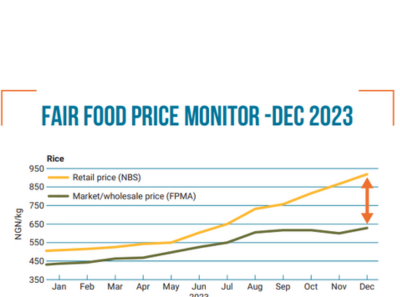
Users can input data on food prices at retail, wholesale, or farmgate level, and the Monitor will generate analysis which indicates whether these prices appear to be diverging excessively. It draws upon factors such as fuel prices and currency exchange rates to determine whether the divergence can be otherwise explained. 

The Monitor applies a system of green, yellow and red 'flags' to highlight where price divergences appear excessive, providing an early warning system for unfair pricing, and enabling further investigation into the causes of such distortions. 

How has the tool been used so far? 

Pilot studies in Nigeria, Ghana, and Kenya demonstrate some of the learnings that can be achieved. Conducted in 2023, these investigations exposed a clear risk of unfair pricing across these countries. We saw a growing divergence between retail and wholesale food prices:

  • In Ghana, the retail price of gari (cassava flour) had risen by 77%, while the wholesale price of cassava had increased by just 46%.
  • In Nigeria, the retail price of yams increased by 74% compared to a 60% wholesale rise.
  • And in Kenya, the retail price of cabbages increased by 17%, while wholesale prices rose by only 7%.


Explore the evidence briefs below for details on these findings. 

We have also used the findings generated by the Fair Food Price Monitor to garner global attention towards the issue among policy-makers and leaders. We shared our findings as part of our advisory role to the United Nations Global Crisis Response Group, as well as presenting evidence at the Committee on World Food Security. 

EVIDENCE BRIEF - NIGERIA  

Evidence brief - GHANA

Evidence brief - KENYA

How can I access? 

The Fair Food Price Monitor is intended to support consumer organisations, government authorities, and other interested partners to produce rigorous yet straightforward analyses of unfair food prices. 

To request access to the Fair Food Price Monitor or a demonstration of how it can be applied, please contact consint@consint.org. If you already have access, please log in at the link below.   

LOG IN HERE

news

World Consumer Rights Day 2026 to focus on ‘Safe Products, Confident Consumers’

World Consumer Rights Day 2026 will focus on product safety, a critical issue in the digital marketplace, impacting lives, consumer trust and the global economy.

READ MORE

blog

Power in Partnerships: Scaling the Consumer Voice in Policy

Explore how consumer advocates are shaping fairer digital finance through partnership, collaboration, and successful BNPL reform.

READ MORE

Our Latest Publication

Global Action Agenda to Protect Consumers from Online Scams

To assist governments in identifying and closing these gaps, this Agenda provides a set of core principles and a checklist of practical policy actions that together will better protect citizens and contribute to a stronger, more coordinated global response.  

French

Spanish

View all publications